Application brief

Indoor led display signs for rooms where people stand close

Indoor led display signs in a lobby, a shop floor or a clinic corridor are specified from the walking path and the service door, not from a stadium cabinet sheet. This page turns that site into purchase questions. It does not rate venues or promise a brightness result.

Review screen labels
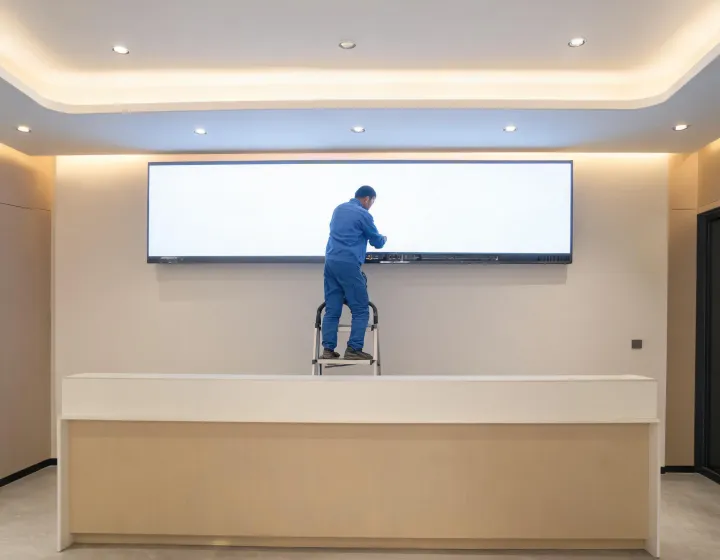
Indoor LED sign above a reception desk with a service ladder nearby

Role routes for signage projects

  1. Procurement route

    Ask whether the sign is one finished wall or several repeated openings. Repeat openings can share pitch and still differ in width. Keep each opening on its own line so a quantity discount conversation does not hide a size change. Currency and destination stay on this route.

  2. Engineering route

    Measure the rough opening, the finished reveal and the depth behind the face. Note structure the sign will hang from only as a buyer input; this desk does not certify the attachment. Power location and cable path belong here, with voltage written or marked unknown. For a retail pier, a buyer might record footprint 2400 mm by 400 mm, ambient temperature up to 30 C, and noise level left blank because the sign has no fan specification yet. Ingress protection stays a question only if the opening is beside a wet service door.

  3. Operations route

    Record ambient light at the hours the message runs, and who changes content. A menu board updated daily needs a control interface the store team can reach. A donor wall that changes twice a year can accept a slower update path if the buyer says so.

  4. Quality route

    Decide the incoming check: dead pixels, seam step, color compared with a reference slide, and label match to the quoted model. If a UL, ETL or FCC file is required for the site, ask the supplier whether that file covers the proposed revision. Do not paste a mark onto the brief yourself.

Handoff sentence for every role: the same pixel pitch, the same openings and the same spare rule go to every factory. See how offers are normalized.

Quotation questions that change a signage project

Does a lower cabinet price describe the installed sign?

Often it describes modules only. Trim, a processor, flight cases, freight to the US site and a technician day can sit outside. Comparable delivered scope lists those layers. A smaller equipment price is a useful screen only after the layers match. This page does not calculate a savings percent.

Should the sign stay a standard module grid?

A standard module grid can be easier to spare. A custom outline may be required for a curved soffit or a narrow pier. Write the constraint and ask the supplier to separate a standard alternative from a deviation. Both can be priced; they are not the same offer.

How should brightness be compared?

Ask for the nit number and the condition: full-white, indoor ambient, or another stated method. A headline rating without that note stays in the early-screening column. Test-basis review is the column used before a purchase recommendation.

Related reading sits on the wall selection page and in the procurement brief.

Compare proposed sign scope after the brief

Send openings, pitch, quantity and destination. Fees, freight and calendar dates wait for supplier paper. Optional budget can be a range. No countdown and no floor price is published here.

Compare Proposed Specifications